

The story, in one line.
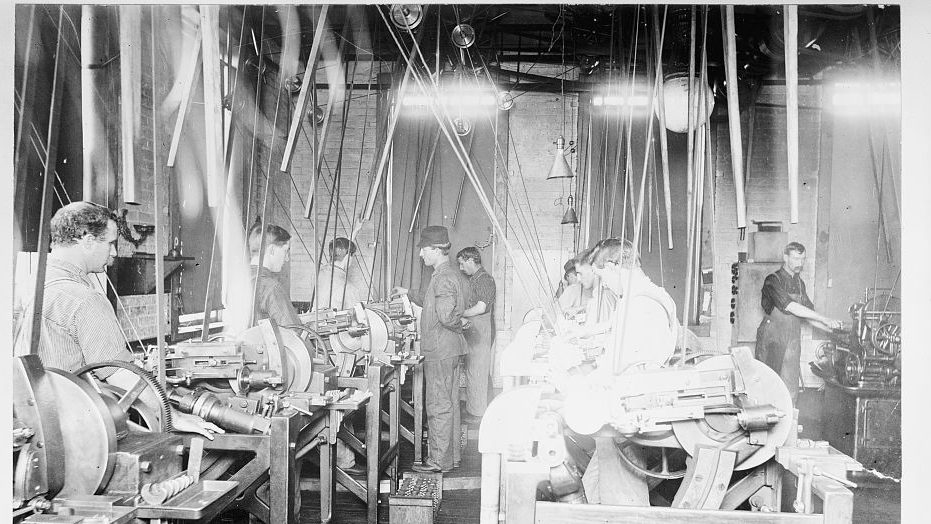
The electric motor was ready by 1900. The boom came in the 1920s, when factories were rebuilt around it instead of fitting it into the old line-shaft floor. A faster tool rises to the ceiling set by the workflow around it. Our shafts are digital: the handovers, the re-typing, the approvals, the judgement nobody wrote down. And nobody in the industry is 10 years ahead of you.
Both talks carry that argument, with the notes behind every slide.
Download the slidesPDF · 15 pages · 2.5 MB
Download the slidesPDF · 13 pages · 2.2 MB
One workflow, two questions.
You do not need a transformation programme. You need one workflow, scored before you automate it.
Start smaller than feels impressive. Then tell me what you found.
Six skills that outlast the tools.
From years as a hiring manager in rail. The tools changed every few years. What I looked for did not.
Thirty days, three moves.
Observe, experiment, adopt. In that order, and no further than you can verify.
Your token quotient.
We talk about IQ and EQ. In this era there is a third: TQ, how fluently you can put a machine's tokens to work and know when not to trust them. Five yes-or-no questions. Tick what is true today.
Verify the output. Five checks.
You can hand over the thinking. You cannot hand over the understanding. This is what the understanding does to an AI output before it goes anywhere.
- Source. Where did each fact come from, and can I open it? An answer without a source is a draft.
- Method. Would I have done it this way? What did it skip, assume or invent?
- Range. Are the numbers physically plausible? Orders of magnitude, units, signs, dates.
- Edge. What happens at the boundary case it was not shown? Ask it, then check the answer.
- Sign. Would I put my name on it as it stands? If not, it is not finished.
Responsible use, in one paragraph. Never paste client data, drawings, commercially sensitive or safety-critical material into a public tool. Use what your organisation has approved. Record what AI produced and what a person verified. The accountability stays with the person who signs, which is what the ICE Code of Professional Conduct, April 2026, already says.
Ten words.
- Token
- The unit a model reads and writes, roughly three quarters of a word. You pay per token, in and out.
- Context window
- How many tokens the model can hold at once: your instructions, your documents, its answer.
- Prompt
- What you put in the window. Prompting is the first rung; context engineering is the second.
- Agent
- A model given tools and a goal, working in a loop until the job is done or it asks you.
- API
- The doorway software uses to talk to other software. How a model gets into your workflow.
- MCP
- Model Context Protocol. A standard doorway between a model and your tools, files and systems.
- Small language model
- A smaller, cheaper model tuned for one job. Often the right one for engineering tasks.
- Harness
- The scaffolding around a model: the checks, the tools, the limits. Where reliability comes from.
- Loop
- Draft, verify, correct, again. The unit of AI-enabled work.
- Evaluation
- A fixed set of test cases you run every time something changes. How you know it still works.
Where to start.
- CS50x, Harvard's introduction to computer science · the foundations, free
- CS50P, introduction to programming with Python · the language of engineering automation
- Google and Kaggle's AI courses · including the five-day agents intensive
- Model Context Protocol · what MCP is, from the source
- Paul David, The Dynamo and the Computer, 1990 · the motor story, in eleven pages
- DfT Transport AI Action Plan, June 2025 · direction
- GBRX, AI in Rail: the Industry Action Plan, April 2026 · delivery
- ORR Safe AI Innovation Action Plan, May 2026 · assurance
- ICE Code of Professional Conduct, April 2026 · the accountability line
The practical version, every fortnight.
A short newsletter every two weeks on AI in rail: what worked, what did not, and one thing to try. Subscribers also get early access to Scribtive® OS when it opens. Free, and easy to leave.
Consent, UK GDPR Article 6(1)(a). See the privacy notice. The same list as the Scribtive waitlist.